
Onboarding for newcomers to Canada
A feature concept that identifies and proposes a potential solution for two friction points in Wealthsimple's onboarding that new users consistently hit.
Type
Feature concept
Scope
2 interventions & 10 screens
Research
Secondary + 4 usability tests
KEY GOALS
Drop-off
at the account-purpose screen for newcomers who don't know which option to pick.
0 Dead ends
in the SIN requirement flow. Every path has a resolution, including the unsure case.
2 Screens
changed in an otherwise untouched flow.
CONTEXT
Canada welcomed 471,550 permanent residents in 2023.
Wealthsimple's pitch is investing for everyone, but the onboarding assumes Canadian financial knowledge that newcomers don't arrive with. They don't know what a TFSA is, if they need or have a SIN, or which account fits their situation. And as Wealthsimple expands into full-service banking, that first experience stops being just an onboarding problem. It becomes a retention one.
The User
Steph, 22
Hong Kong → Vancouver.
International student
UBC $2,000 sitting idle.
Heard about TFSA, googled it, landed on CRA, closed the tab.
The Feeling
Sorry if I sound dumb.
Scared of penalties for getting it wrong. Keeps thinking she'll figure it out later
The Frame
One guiding principle
She doesn't need to understand everything. She just needs to feel confident she didn't do it wrong.
FLOW
Two screens in an otherwise unchanged flow.

RESEARCH
The rules exist. They just can't be verified.
Product audit of Wealthsimple's onboarding and help documentation, combined with a review of reddit/PersonalFinanceCanada. The same four patterns showed up consistently across newcomer posts on reddit.
Shame
"Sorry if I sound dumb as I'm still new to Canada."
Never make users feel like outsiders for not knowing something.
Distrust
"Is this accurate? People say don't always trust CRA."
Be the authoritative voice they can't find anywhere else. Say it plainly.
Paralysis
"My friend said I have to wait a year. I couldn't find anything online."
Misinformation causes inaction. Correct it early. Don't assume they already know.
Fear of mistakes
"$90k TFSA contribution room, is this a glitch? Am I missing something?"
Answer the scary question before they have to ask it.
KEY INSIGHTS
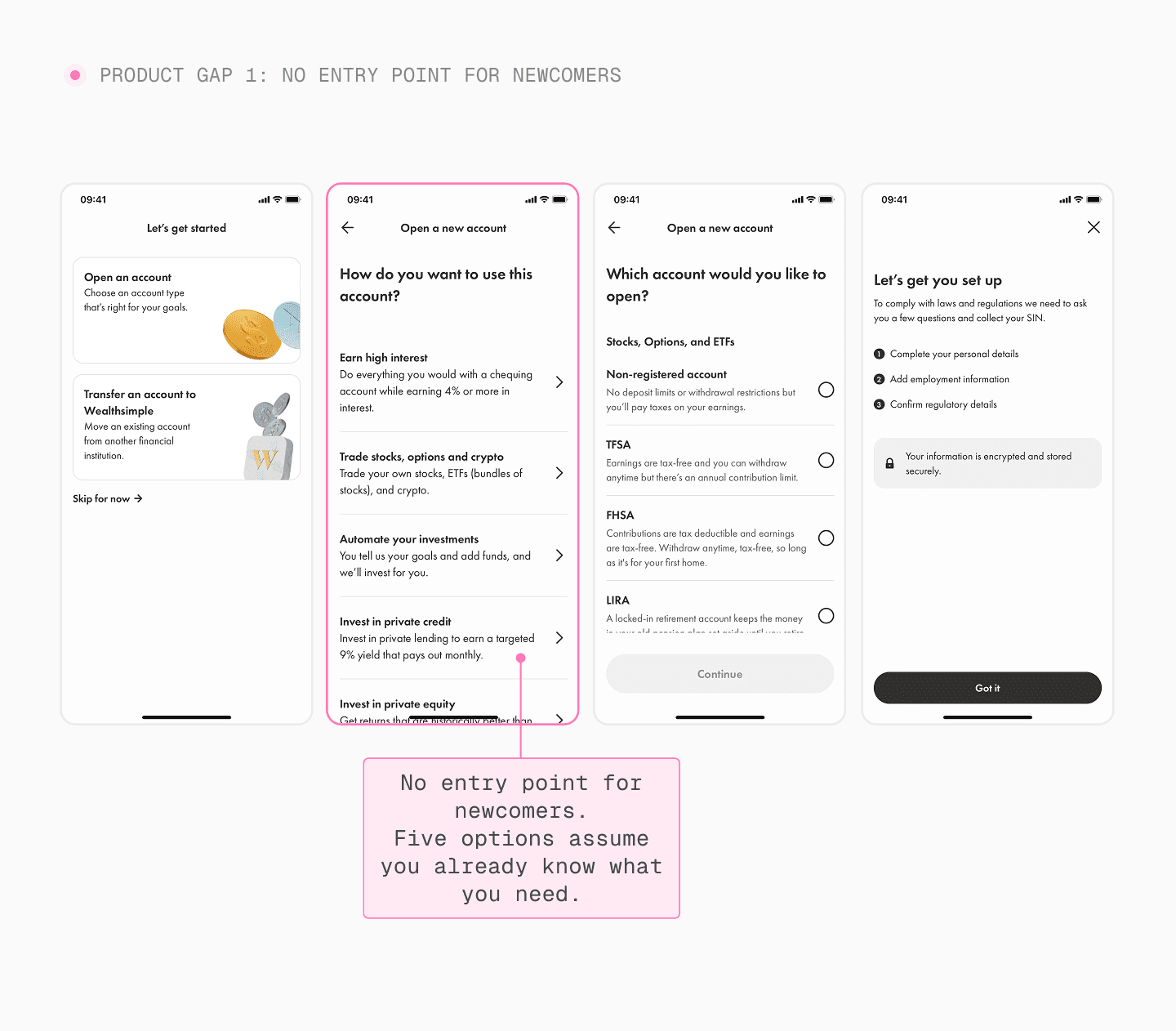
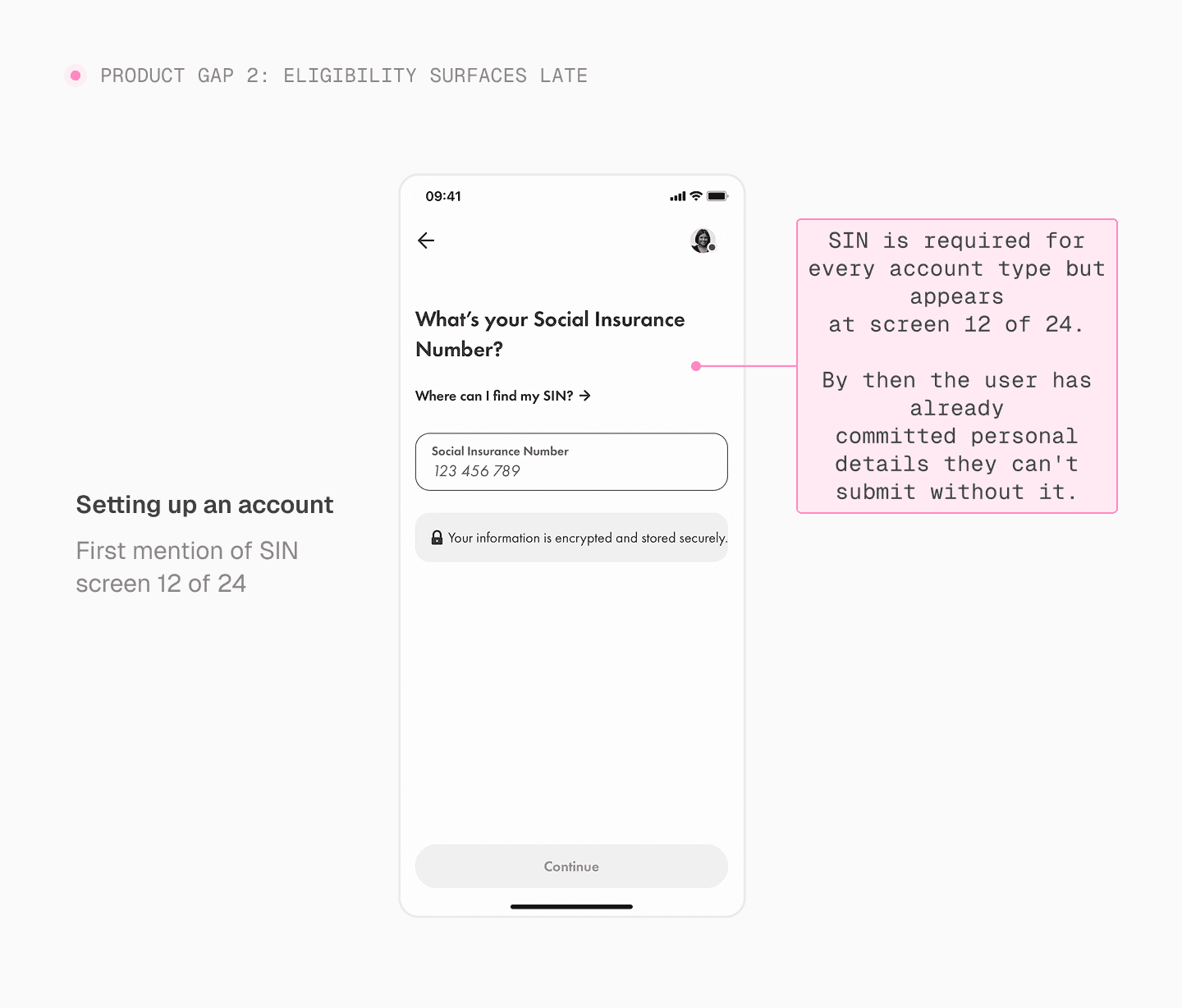
The problem isn't that newcomers lack information but it is that the current flow doesn't meet them where they are. The existing flow assumes knowledge users don't have and hides some requirements until it's too late to prepare.
INTERVENTION 1: Newcomer path
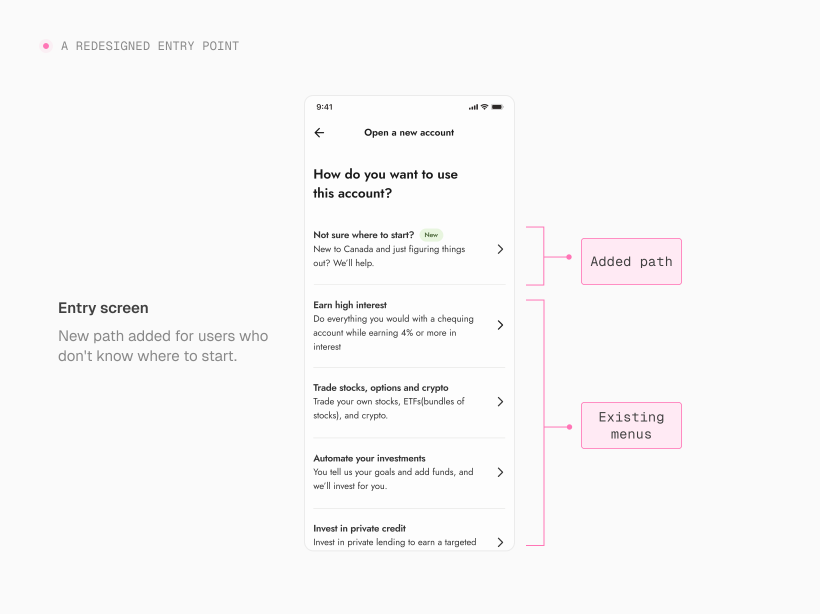
A NEW PATH
Why a question beats a sequence
The account-purpose screen gives five options and assumes you already know which one you need. That's fine if you do. Newcomers don't.
FIRST ATTEMPT
A sequence that still made assumptions
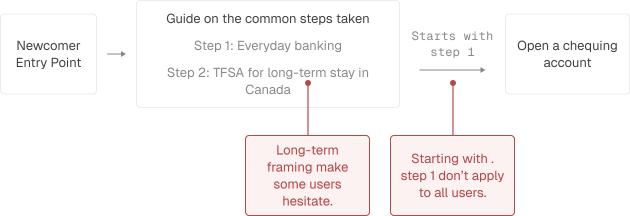
The first attempt gave newcomers a two-step plan - open a chequing account, then a TFSA when ready. It felt structured and logical. Testing broke it pretty quickly.
Usability Testing Insights
2 participants already had chequing accounts at other banks. Step 1 didn't apply to them and the screen had no answer for that.
A 3rd participant paused at the TFSA step. The framing assumed she had already decided to stay in Canada long term but she hadn't.
ITERATIONS & FINAL FLOW
Why a better sequence wasn't the answer
The problem wasn't the steps themselves. It was that any fixed order still decides something on behalf of the user. Step 1 assumes you don't have banking yet. Step 2 assumes you've settled the question of how long you're staying. Both are reasonable guesses, but guesses are exactly what we were trying to get away from.
If the goal was to meet newcomers where they actually are, a fixed flow couldn't do that, it can only meet them where we assumed they'd be. The only way to genuinely not assume anything was to ask first. So that's what replaced it, one question, and then a recommendation built from the answer rather than built in advance.
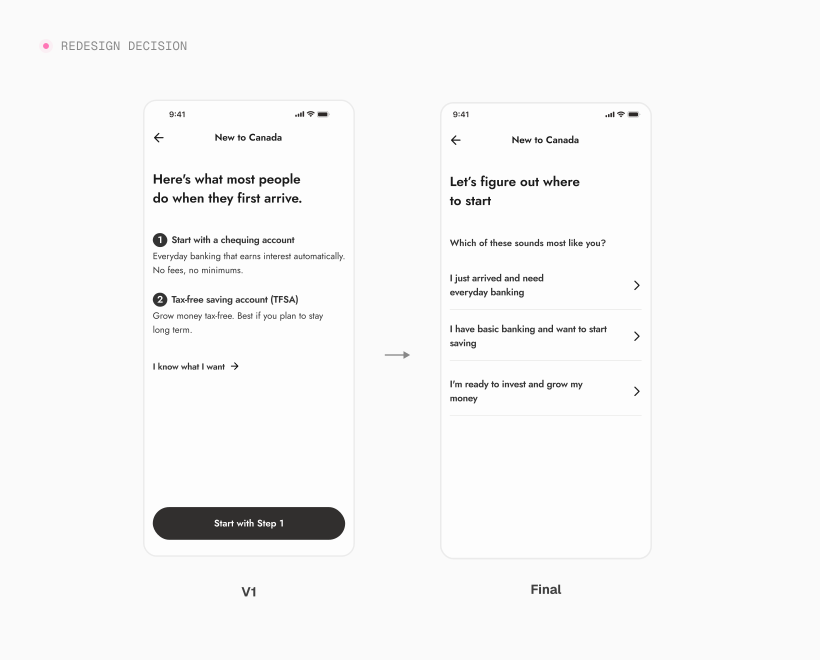
From there I refined the flow into its final version.
Wealthsimple's product voice is one of the clearest in Canadian fintech, direct, warm, with no jargon. Every word on the recommendation screen had to earn its place. Three decisions in particular shaped how the screen reads.
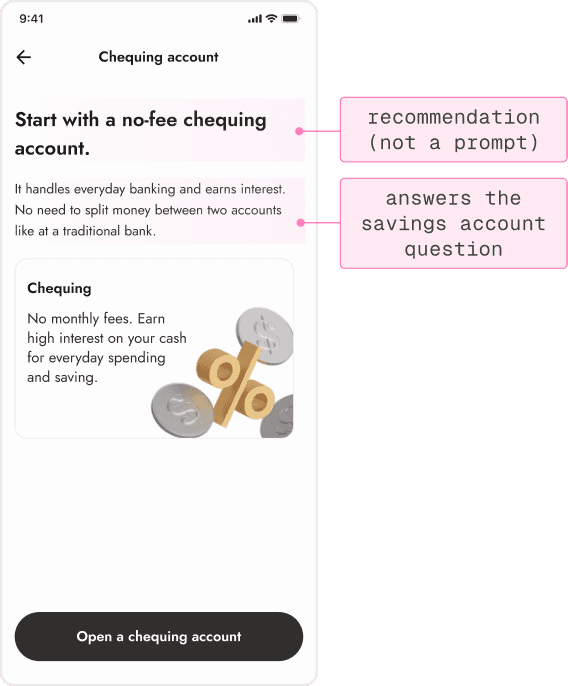
Copy Decisions
Start with a chequing account.
Users came here because they don't know what to pick.
AND earns interest
Newcomers from most banking systems expect chequing and savings to be separate. This line answers that before they ask.
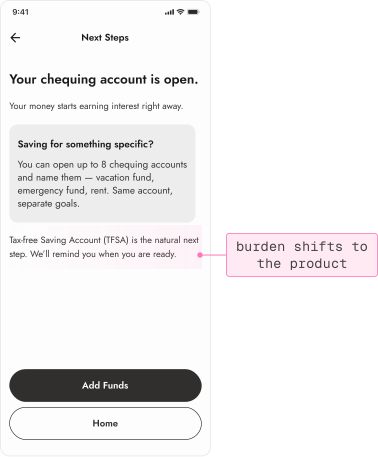
We'll remind you.
Plants the TFSA without creating pressure. Users don't have to hold it in their head.
The timing when we would remind users would depend on data when users typically stabilize their banking after arrival. Will be a later discussion of product + engineering
FINAL FLOW
Newcomer path
Intervention 2: SIN first flow
REQUIREMENT FLOW
Surface the hard requirement early
Wealthsimple requires a SIN for every account, registered or not. It only surfaces mid-form, after 10+ screens of data entry. Users hit a wall they couldn't have seen coming. If a newcomer doesn't have one, everything entered before this point can't be submitted.
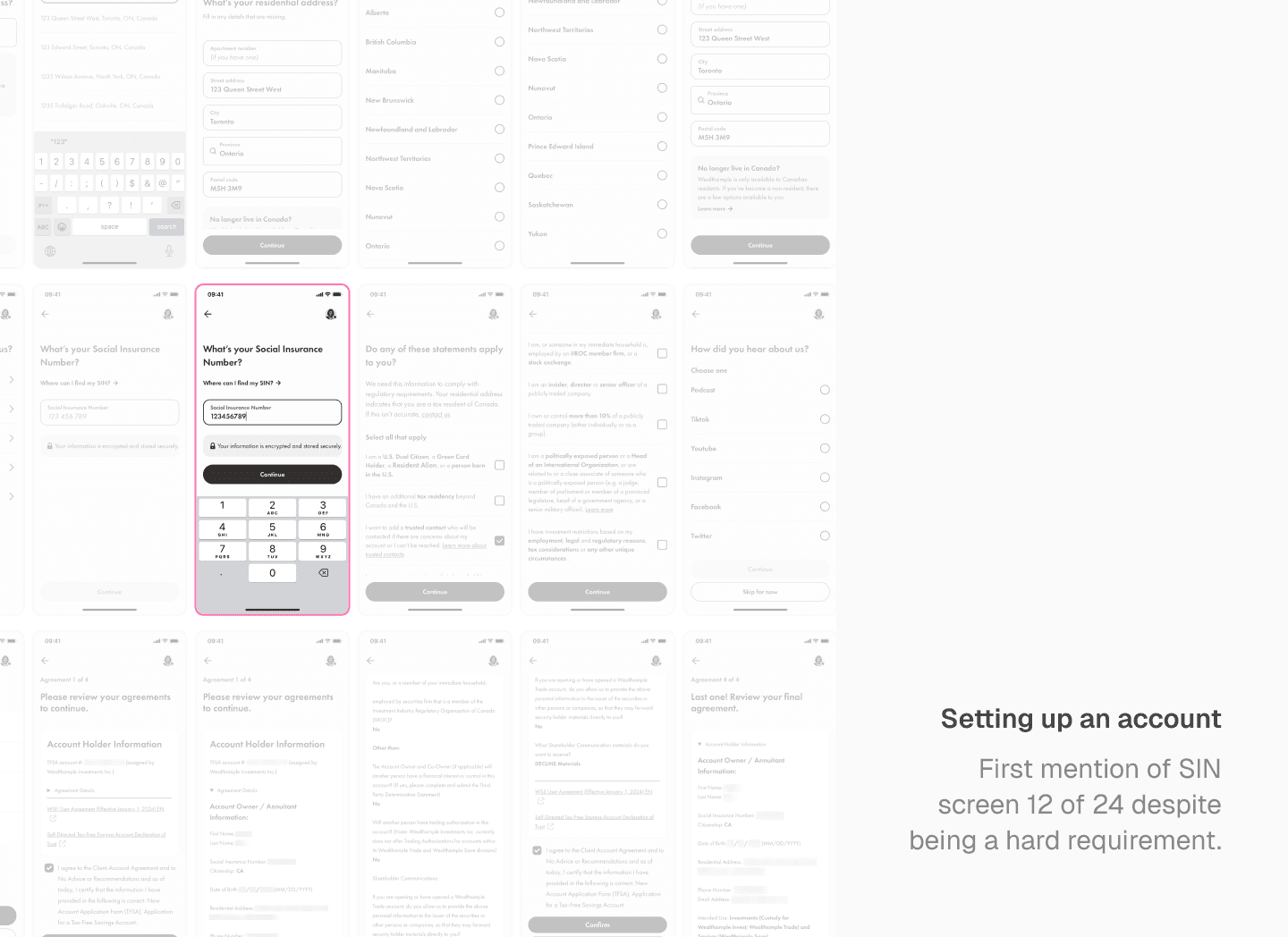
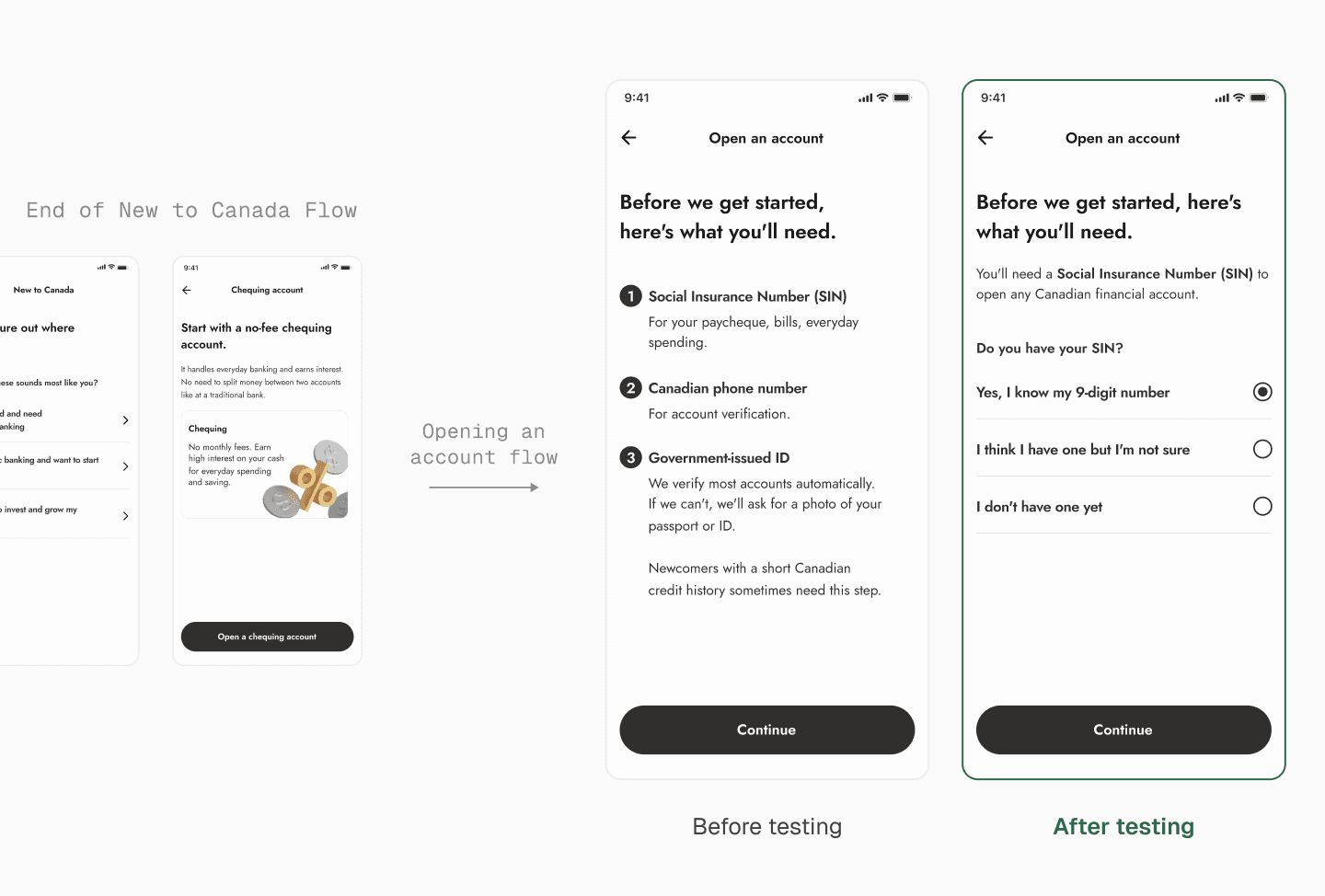
So instead of hiding the SIN requirement deep in the flow, I decided to surface it early, right after user decides to open an account. Below are the first iterations before the testing and the final version user testing.
BEFORE TESTING
The third state we didn't see coming.
The first version moved the SIN requirement before the form - a checklist of what you'd need, with a link if you didn't have one. It assumed two states: you have a SIN, or you don't. That felt complete going in.
However, 2/4 participants fell into a state the first version had no answer for. They'd received a SIN when they arrived in Canada , likely in a letter from Service Canada, but had no idea that's what it was.
"I think I got something in the mail but I filed it away. I'm not sure if that's the one."
Neither yes nor no. A third state the checklist couldn't handle.
HANDLING AN EDGE CASE
Why not sure needs its own path.
A no and a not sure look identical from the outside, but they have completely different solutions. A no means apply for a SIN, which takes 1–2 weeks through Service Canada. A not sure means check your T4, your employment contract, or letters from Service Canada, you likely already have one.
Sending someone in the second group down the first path wastes weeks and creates distrust at exactly the moment the product is trying to earn it. The fix was the same logic as the entry point: instead of assuming a state, ask first. The question replaced the checklist, and a third path handled the middle case.
FINAL SOLUTION
Newcomer path + SIN first flow

End
WHAT COMES NEXT
This is a concept. Here's what I'd want to know before it shipped.
Does asking work better than telling?
The personalized question is a hypothesis that meeting users where they are reduces drop-off more than a guided sequence does. That needs to be tested with real traffic, not just 4 participants. An A/B test against the existing flow would answer it.
What does settled actually mean for a newcomer?
The TFSA nudge says "we'll remind you when you're ready" but readiness isn't a single moment. It depends on visa status, employment, how long someone has been here. Understanding that threshold better, through interviews with newcomers at different stages, would make the timing of that nudge meaningful instead of arbitrary.
Scope
This project was deliberately scoped to two intervention points. Other friction exists in the flow, such as account type labelling, the non-registered account naming, but those felt like content and taxonomy problems better owned by a content designer than an issue solved through interface changes alone.